
BMW Engines and ECU Families We’ve Seen So Far
N20/N26 four-cylinders, N54 and N55 six-cylinders, newer B-series cars, S55 M cars and N63/S63 V8 applications. A look at the ECU families we’ve encountered and a few of the features owners have asked us for.

N20/N26: more variations than you might expect
The N20/N26 has been a big part of our work, including our own BMW 428i. One thing that keeps coming up is just how many versions there are. Two owners can both have a 2.0-litre BMW, ask for the same feature and still have different ECU and software versions.
The 2.0-litre N20 combines a turbocharged four-cylinder layout with direct injection, Valvetronic valve control and a twin-scroll turbo.
The N26 is the closely related SULEV emissions version. That means an N20/N26 badge in a tuning app is a useful starting point, but there is more to identifying the car’s setup. Across our work on these engines, we’ve encountered MEVD17.2.4, MEVD17.2.9 and MEVD17.2.P controllers, along with multiple software versions.
If those names look unfamiliar, N20 or N26 identifies the engine family; MEVD17 identifies the ECU family. BMW also uses the term DME for its petrol engine management. The full controller designation and its software version give us a more specific picture of the car.
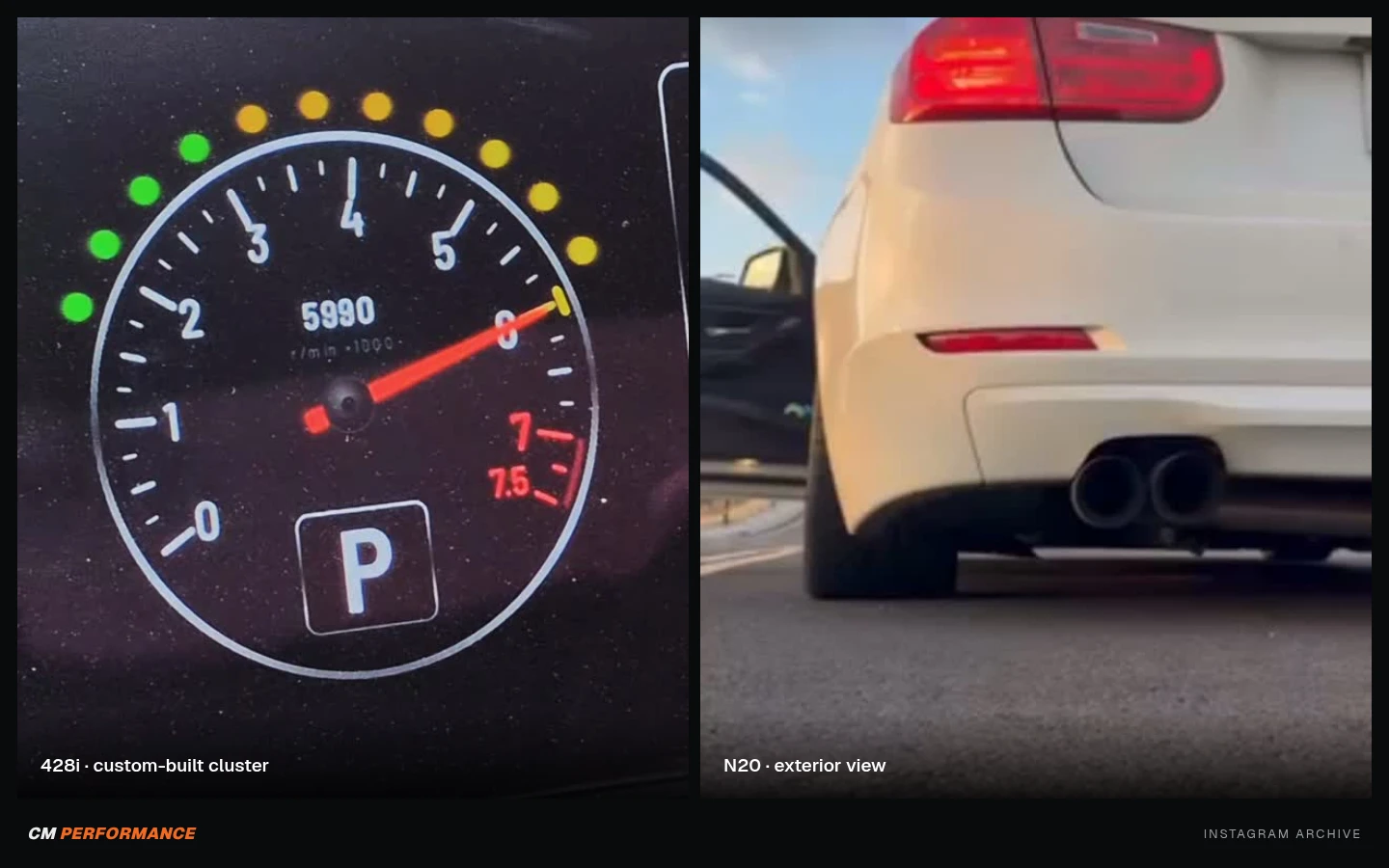
Two examples from our Instagram: a 428i M1/M2 demonstration with a custom-built instrument cluster and an N20 exterior view.
The ECU families we’ve seen so far
The controller names can look very similar on a list. The suffixes matter, though: MEVD17.2.4 and MEVD17.2.G identify different variants within the wider MEVD17 family.
Here are some of the controller designations that have appeared in our work so far:
| ECU family | Variants we’ve encountered | Engines and examples |
|---|---|---|
| MSD80 | MSD80 | N54: 335i |
| MSD85 | MSD85.1 | S63: E70 X5 M |
| Bosch MEVD17 | MEVD17.2.4, MEVD17.2.9, MEVD17.2.P | N20/N26: 428i |
| Bosch MEVD17 | MEVD17.2, MEVD17.2.6, MEVD17.2.G | N55: M135i, 335i, 535i and X3 |
| Bosch MEVD17 | MEVD17.2.G | S55: F80 M3 and F82 M4 |
| Bosch MEVD17 | MEVD17.2.H | N63TU applications, in development |
| Bosch MG1 | MG1CS003 | B48/B58 applications, including the 330e hybrid |
Even a matching controller name does not tell you everything about feature availability. Software versions, the controls fitted to the car and its existing tuning platform also matter. That is why we ask for the specific car’s details when someone sends us a clip and says, “Can mine do that?”
There are useful differences even within familiar model names. Our 335i work, for example, includes both N54 and N55 applications. The 330e adds a hybrid drivetrain to the picture. The model name, year and engine details all help establish which version we’re discussing.
This is our experience to date. We continue to take on other cars and ECU versions, and the feature options are confirmed for each setup.
M1/M2 Buttons for 2-Step
Fitting a steering wheel with M1/M2 buttons to a non-M BMW doesn’t automatically make those buttons work. Some retrofit solutions make them function as drive mode selectors.
On the compatible N20/N26 setups we’ve worked with, we’ve repurposed them to activate 2-step at two different RPM limits. The ECU recognises the button presses as native inputs, so our 2-step setup requires no additional wiring.
In the N20/N26 example below, M1 activates 2-step at 4,000 RPM and M2 at 6,000 RPM, giving the driver two settings directly from the steering wheel.
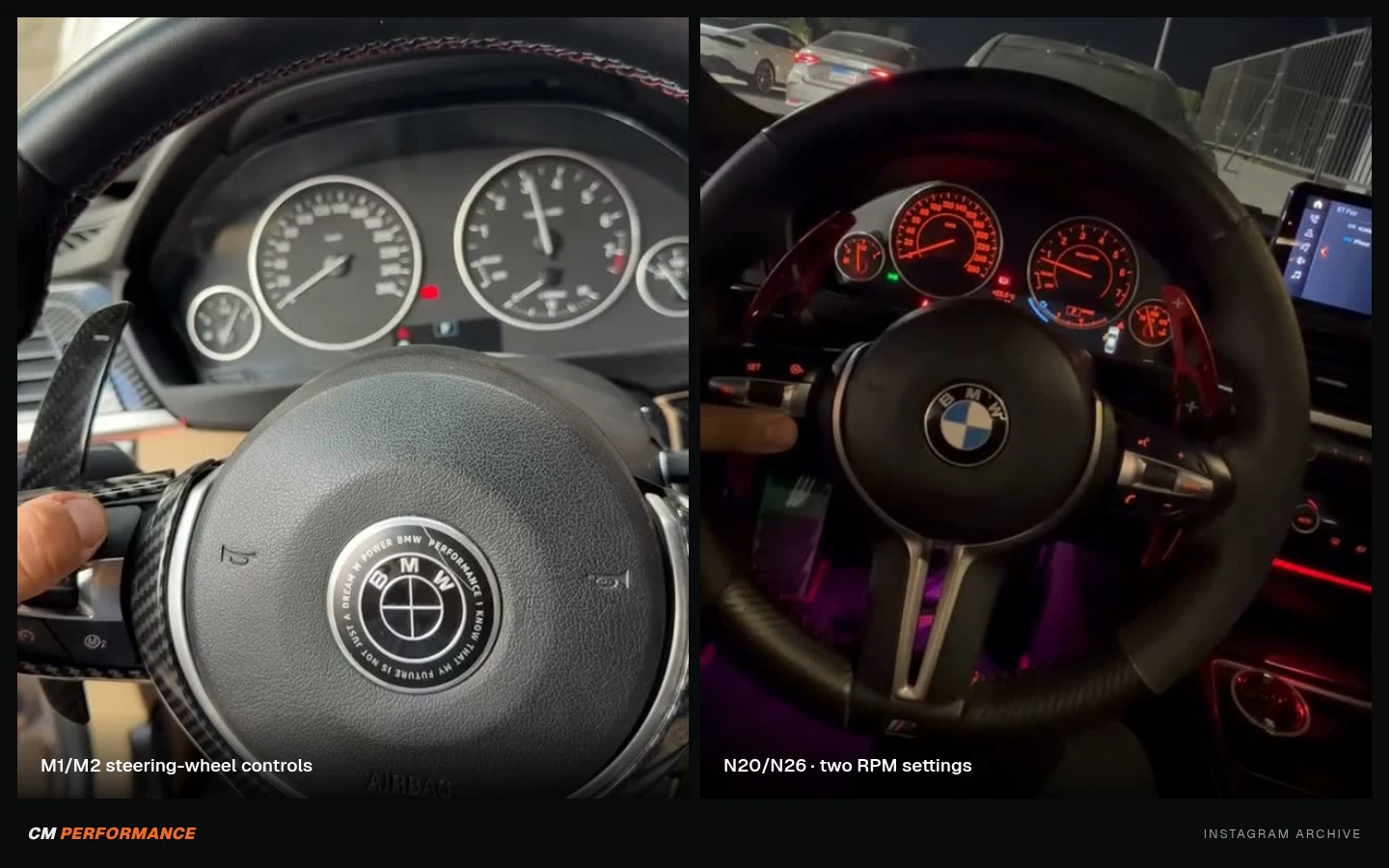
The two photos show separate cars. The N20/N26 example on the right uses the 4,000/6,000 RPM settings. Watch the left-hand wheel demonstration.
Rolling 2-step and native rolling anti-lag
Our Instagram also includes an earlier rolling 2-step demonstration at 3,000 RPM on an N2X application. The original clip shows that particular setup in use.
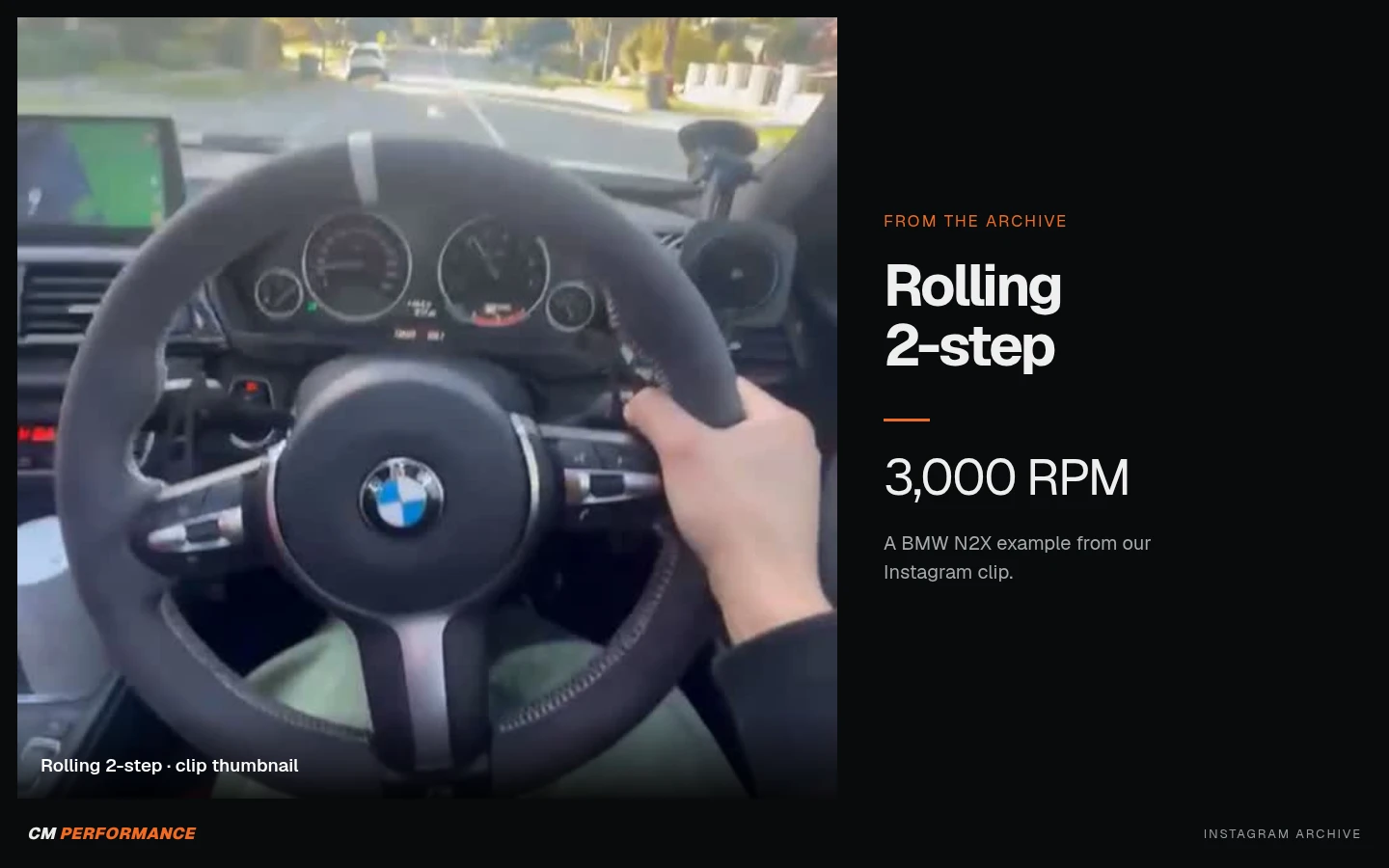
Watch the 3,000 RPM rolling 2-step clip.
More recent requests include adding ignition-cut sound to native rolling anti-lag on MHD and Bootmod3 applications. Our M135i and M140i work has included that feature. Rolling 2-step and native rolling anti-lag are distinct options, so we confirm which behaviour an owner wants when discussing their car.
If you enjoy our content, follow @cm.perf on Instagram to see more of our work.